
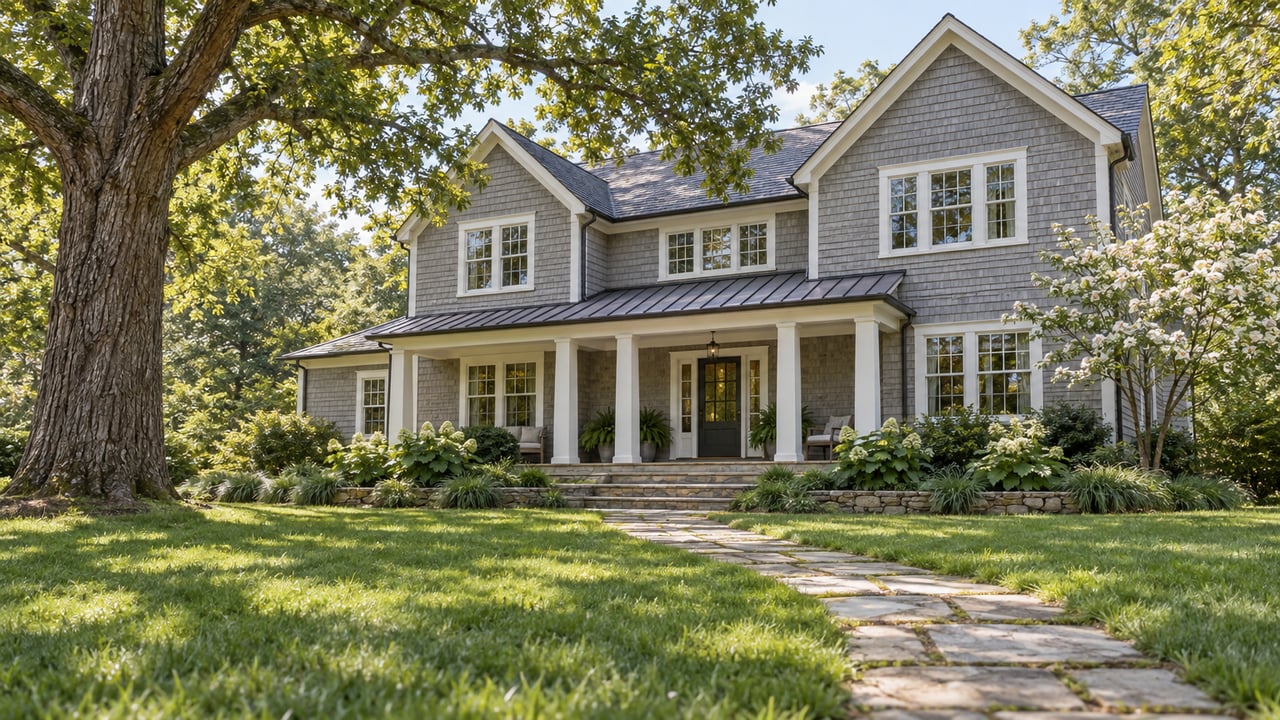
Walk east along Ponce de Leon Avenue past Lakeside and you'll notice the forest floor looks different than it did last year. Sections of the understory are open where they used to be choked with glossy green ground cover. Bare mulch marks where crews worked through winter dormancy to get at terrain that's impossible to reach once the canopy leafs out. If you've lived in Druid Hills long enough to walk this stretch on autopilot, the change is the kind of thing you register without quite placing.
That's Deepdene, the 22-acre wooded segment at the eastern end of Olmsted Linear Park, and it's the only one of the park's six segments still being actively rebuilt. The other five were restored, fixed in place, and handed back to the neighborhood years ago. Deepdene is different in kind, not just in degree, and the distinction matters if you're the kind of resident who treats this park as daily infrastructure rather than scenery.
Frederick Law Olmsted drew the plan for what would become Druid Hills in the 1890s, and the linear park along Ponce de Leon was its spine. Six segments run from Springdale near Moreland Avenue to Deepdene at the eastern edge, and five of them share a family resemblance: open lawns, mature shade trees, and paths built for walking, running, or pushing a stroller. The Olmsted Linear Park Alliance's own description groups them together as "pastoral," which is the right word. They're meant to be looked at as much as used.
Each has a history worth knowing if you're going to keep walking past it:
The Alliance's restoration work across all six segments added nearly 6,000 linear feet of new paths and roughly 2,600 trees and shrubs, and buried about 11 miles of utility conduit and cable that used to run overhead. That work is done. Springdale, Virgilee, Oak Grove, Shadyside, and Dellwood get mowed, maintained, and occasionally repaired, but nobody is out there redesigning them. They finished becoming what they're going to be.
Deepdene never fit the pastoral mold. It's 22 acres of old-growth forest with a stream running through it and a stream corridor for coverage, not a lawn to view. That's precisely why it required a different kind of restoration.
The stream itself had been eroding for the better part of a century, the result of a large drainage pipe that had never been properly stabilized. The landscape architecture firm Tunnell & Tunnell tackled it as the final and largest phase of the Alliance's restoration, starting with a four-acre demonstration area to prove that invasive plants like English ivy could actually be controlled and slopes actually stabilized before scaling up. From there, the team used the Rosgen Method, a stream restoration approach built around cross vanes, pools, and riffles that slow and redirect water flow, reinforced with coir fabric and native, water-tolerant plantings on the graded slopes. That phase addressed the structural erosion. It didn't finish the job.
Since the summer of 2024, the Alliance has partnered with Woods Keeper, a native-plant restoration company, and Birds Georgia on what they call a Native Habitat Management Strategy for Deepdene. The goal is straightforward: push out the invasive plants that have taken over sections of the forest floor and give native species room to come back.
The target list is specific. Woods Keeper crews have been working through privet, horned holly, mahonia, elaeagnus, and the evergreen English ivy that's easy to spot in winter precisely because it doesn't go dormant like everything else. Wisteria and chaff flower are harder problems, flagged as two of the toughest plants the partnership is still working through. In their place, crews have been making room for natives like spicebush and bloodroot.
A March 2026 update from Woods Keeper laid out the seasonal logic behind the timing. Winter dormancy makes the creek corridor's difficult terrain easier to access before the growing season fills back in, so the heaviest push happens in the colder months, with monitoring and follow-up work continuing as things green up. If you walked Deepdene this past winter and saw more open ground and flagged plants than usual, that's what you were looking at. If you walk it again this fall, some of the native plantings from earlier in the year should be visible as established growth rather than bare dirt.
None of that is happening in Springdale, Virgilee, Oak Grove, Shadyside, or Dellwood. It's a Deepdene-specific project, tied to Deepdene-specific terrain, on a Deepdene-specific timeline.
A few practical details are easy to forget if you don't visit often. There's no parking lot at any point along the park, by design, so access is on-street along South and North Ponce de Leon Avenue. MARTA's Route 2 bus runs the Ponce de Leon Avenue and Decatur corridor if you'd rather not deal with parking at all. The paved paths at the road entrances are ADA compliant, and the park keeps the same hours as the rest of Atlanta's park system, six in the morning to eleven at night.
None of that has changed. What has changed is which segment rewards a slower look. If you're walking the park end to end, the five pastoral segments are the same well-kept version of themselves they've been for years. Deepdene is the one place where paying attention this season shows you something that wasn't there last season.
Restoration work like this doesn't fund itself, and the Alliance runs two recurring events that keep it going. The spring Green & Gold Gala, held at Fernbank Museum of Natural History, has drawn roughly 250 guests in a recent year and raised more than $65,000 for park preservation and tree care. In the fall, the Alliance hosts a Fall Soirée at Callanwolde Fine Arts Center, drawing around 150 park supporters for an evening built around a Fund-A-Need pitch. Executive Director Sandra Kruger and Vice President Justin Critz have both led remarks and appeals at recent versions of the event, tying the ask directly to the Deepdene work rather than general park upkeep.
If you've been meaning to see what your donation to the Alliance actually buys, this is it. It's the crews clearing privet in January so the spicebush has room to come up in March.
Deepdene won't stay a construction zone forever. At some point the invasive removal will taper into maintenance, the way it did for the other five segments, and the whole park will read as one continuous, finished thing again. For now, walking east past Lakeside still means walking into an active restoration, not just a shaded stretch of trail.
If you're curious how a neighborhood built around a 130-year-old park plan actually holds up street by street, Margaret Sallee knows Druid Hills well enough to talk through it, restoration work included.
Whether buying or selling, Margaret represents each of her clients with a high degree of professionalism and personalized care that delivers optimal results.